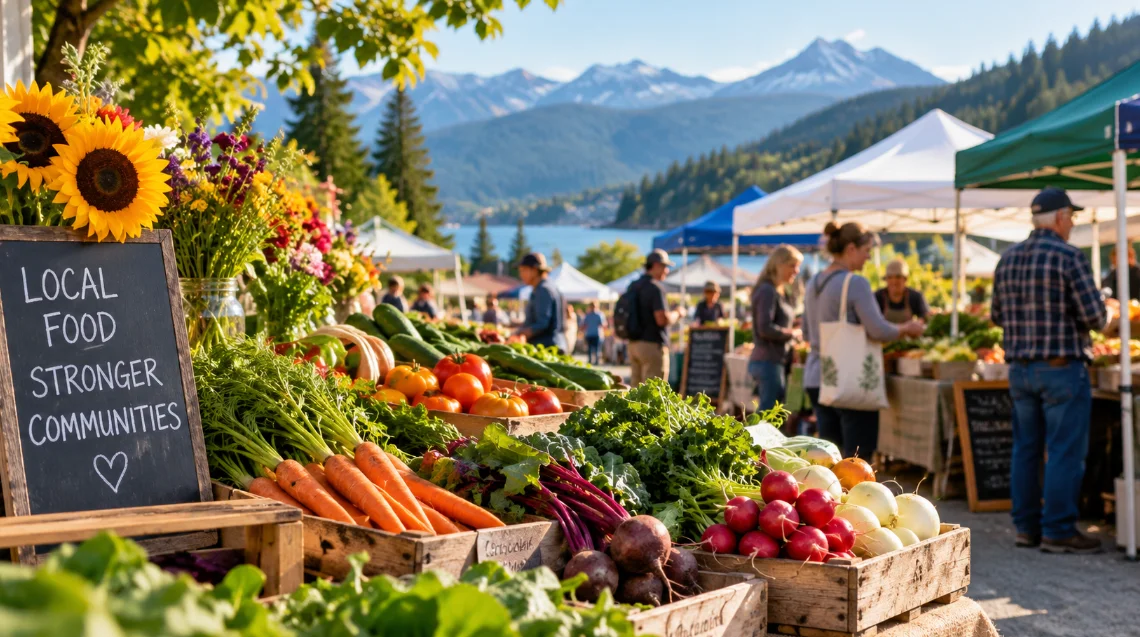
A farmers’ market needs more than a collection of producers willing to set up stalls. Someone has to secure a suitable location, coordinate vendors, manage food safety requirements and make sure the event can operate even when attendance or the weather doesn’t cooperate.
For smaller communities in British Columbia, the challenge is finding a model that supports local growers without creating an expensive event that volunteers struggle to maintain. A successful market doesn’t necessarily need dozens of stalls or a weekly schedule. It needs enough committed producers, a manageable budget and a reason for shoppers to return.
Start With the Community Need, Not the Event Date
Before booking a location, establish whether the community needs another market and whether local producers can support it throughout the proposed season.
A market built around a single enthusiastic opening day may struggle once the novelty wears off. Its longer-term value depends on repeat customers, reliable vendors and a schedule that works for both.
Identify Your Shoppers, Producers and Existing Markets
Begin by mapping the local food network. Identify nearby farms, small-scale food producers, bakers, artisans and organizations already connecting consumers with local agriculture.
Then look at existing markets.
In the West Kootenays, communities such as Rossland, Trail, Castlegar and Nelson already have established traditions of local food markets. Rather than assuming a new event would attract additional customers, consider whether it might compete for the same vendors and shoppers.
Speak with producers about their availability, harvest schedules and interest in another selling opportunity. A farmer attending two established markets may have little capacity for a third, particularly during peak harvest.
For shoppers, ask practical questions. Would a weekday afternoon market serve people who cannot attend on weekends? Is there demand for fresh produce within walking distance of residential neighbourhoods? Would a winter market offer something unavailable locally?
In some communities, partnering with an established market or organizing a seasonal extension makes more sense than creating a separate organization.
Decide What Makes Your Market Distinct
A market needs a recognizable purpose beyond providing another place to buy things.
For one community, that might mean prioritizing locally grown vegetables and farm products. Elsewhere, a small harvest market combining food, crafts and community activities may suit the available producers.
Rossland Mountain Market’s historical programming illustrates the community-oriented approach: farm products, handcrafted wares, local musicians and shared meals were part of its market identity.
The practical lesson is that food should remain central while complementary activities make the market welcoming.
Avoid building the event around attractions that overwhelm the producers. If the goal is to support local agriculture, shoppers should have a clear reason to visit the farm stalls.
Choose an Operating Model and a Suitable Location
A farmers’ market can be operated by a volunteer society, an established non-profit organization or an independent organizer. The right structure depends on who will make decisions, handle money and accept responsibility for the event.
Volunteer Society, Non-Profit Partner or Independent Organizer
A volunteer-led society offers community participation and a structure for shared governance. In BC, incorporated societies operate under the Societies Act, which establishes requirements for directors, records and organizational purposes.
Incorporation is not mandatory for every community group, but it can provide a separate legal identity and access to certain funding opportunities. It also introduces ongoing administrative responsibilities.
Working with an existing non-profit can reduce the burden of creating a new organization. However, responsibilities for contracts, insurance, funds and volunteers must be agreed upon rather than assumed.
An independent organizer may make decisions more quickly, but the model still needs clear financial accountability and appropriate insurance.
Whatever structure is chosen, designate one person or committee with authority to make operational decisions. A market cannot function efficiently if every schedule change requires an informal vote.
Weekly, Biweekly or Seasonal Market?
Frequency should reflect producer capacity and customer demand.
A weekly market offers consistency and can encourage repeat shopping. It also requires dependable staffing, regular vendors and enough seasonal products to sustain interest.
A biweekly market reduces the workload and may suit communities where producers already attend other events. The drawback is that shoppers need to remember which weeks the market operates.
A seasonal or occasional market works well for harvest celebrations, winter artisan events or communities with a limited vendor base. It creates less ongoing pressure but offers fewer opportunities for customers to develop regular purchasing habits.
For a new small-town market, a short pilot season can provide useful evidence before committing to a full calendar.
Municipal Land, Private Property and Indoor Venues
A municipal street or park may offer excellent visibility, but access to public land comes with approval requirements.
The City of Rossland requires an Outdoor Special Event Application for various organized activities on City property, including events held on municipal roadways. Applications must be submitted at least eight weeks before the proposed event.
Rossland also requires a minimum of C$2 million in comprehensive liability insurance for events on City property, naming the municipality as an additional insured.
Its event policy warns organizers against advertising or making financial commitments before receiving the necessary written approval.
Private property may simplify some arrangements, but it does not remove applicable food safety, business, building or other regulatory requirements. Written permission from the property owner is essential.
Indoor venues provide more protection from weather but introduce rental costs, occupancy limits and different loading arrangements.
Choose a location based on its overall operating practicality, not simply its appearance.
Build a Budget Before Confirming Vendors
A market should have a credible financial plan before organizers promise vendors particular dates, facilities or promotional support.
The budget needs to distinguish between equipment purchased once and expenses that recur every market day.
Startup Costs Versus Recurring Market-Day Costs
Typical costs include insurance, venue rental, signs, equipment, waste collection, promotion and market coordination.
| Budget item | Cost type | Planning consideration |
|---|---|---|
| Insurance | Recurring | Coverage required by the venue and activities |
| Signs and equipment | Mostly startup | Reusable signs, barriers, tents and supplies |
| Site rental | Recurring | Municipal fees or private rental agreement |
| Market coordination | Recurring | Paid coordinator or volunteer workload |
| Promotion | Both | Launch materials and regular market updates |
| Emergency reserve | Ongoing | Weather cancellations, repairs or unexpected expenses |
These categories are planning considerations, not quoted costs for a specific BC market.
Before setting stall fees, request actual estimates from the municipality, insurer and relevant service providers.
The BC Association of Farmers’ Markets (BCAFM) provides general guidance indicating that vendor stall fees can range from C$10 to C$100 per market day. Individual markets establish their own rates.
Vendor Fees, Sponsorships and Community Support
Vendor fees are often a predictable source of operating revenue, but they need to reflect what producers can reasonably afford.
Consider an illustrative 14-stall market charging C$35 per stall. If every stall is occupied, gross stall revenue would be C$490 per event. With only 10 paying vendors, it would fall to C$350.
Those are hypothetical figures, not published Rossland market rates. They demonstrate how quickly small changes in attendance can affect a modest operating budget.
Organizers should compare expected revenue against the full cost of running each market, including coordination time. If expenses exceed reliable fee income, the difference needs another source of funding.
Local sponsorships, community partnerships and donations may help. Sponsorship agreements should explain what recognition sponsors receive without allowing commercial promotion to dominate the market.
What Happens if Attendance Falls Below Expectations?
A new market may need several events before shoppers develop a routine.
Build a reserve into the budget and avoid relying on perfect stall occupancy. Consider what happens if several vendors cancel, a smoky afternoon reduces attendance or bad weather forces an event to close early.
A practical response may involve shortening the pilot season, reducing equipment costs or adjusting the schedule.
Do not cut expenses that support food safety, accessibility or emergency preparedness merely to keep the market operating.
Recruit a Vendor Mix That Gives People a Reason to Visit
The number of stalls matters less than whether shoppers can find a worthwhile range of products.
A small market with vegetables, fruit, baking, preserves and a few complementary artisan stalls can offer a more useful shopping experience than a larger event dominated by similar merchandise.
Balance Farm Produce, Prepared Foods and Local Crafts
Start recruitment with primary producers. Fresh vegetables, fruit, eggs and other farm products give a farmers’ market its central purpose.
Prepared foods and local crafts can broaden the experience, provided they fit the market’s rules.
For a hypothetical 16-vendor pilot market, an organizer might initially aim for six farm producers, four prepared-food vendors and six complementary artisans or other eligible vendors. This is an illustrative planning mix, not a prescribed ratio.
Actual recruitment should respond to available producers and any criteria applying to the market’s association membership.
If three farms offer similar vegetables, assess whether their products genuinely complement one another. Equally, avoid rejecting useful overlap automatically: customers may appreciate having a choice between growers.
The goal is a coherent selection, not a rigid quota.
Set Transparent Vendor Selection Criteria
BCAFM’s guidance emphasizes goods made, baked, grown, raised or wild-harvested by vendors in British Columbia. Individual markets may impose additional local requirements.
Establish written selection criteria covering product eligibility, quality, category balance, documentation, attendance and conduct.
Explain how applications are reviewed and whether occasional vendors are accepted.
New producers may appreciate a separate explanation of applying to sell at a farmers’ market, including costs and first-day preparation.
A transparent selection process reduces disputes and helps vendors decide whether the market is suitable before investing in equipment or inventory.
Understand the Rules Before Opening Day
Organizers are responsible for coordinating the event, but individual vendors also have regulatory obligations. Those responsibilities should be documented rather than left to informal conversations.
Food Safety and Health Approvals
In the West Kootenays, Interior Health is the relevant regional health authority for food premises and temporary food services.
It distinguishes between vendors selling lower-risk pre-packaged foods, those selling higher-risk products and operators preparing food for immediate consumption.
Qualifying lower-risk packaged foods generally do not require authorization from an Environmental Health Officer. Higher-risk packaged foods, eggs and frozen meat, poultry or fish require approval.
Temporary food services follow a separate application process. Under Interior Health’s guidance effective October 1, 2025, applications are generally due at least 14 days before an event, and late submissions are subject to an administrative fee.
Market managers should identify the types of food vendors being recruited and confirm that required documentation is available before opening.
For a closer look at product categories, documentation and approval routes, it helps to understand which market foods require health approval.
Event Permits, Insurance and Site Conditions
Municipal requirements depend on the location, ownership and nature of the activity.
For Rossland events, the City’s approval process may address street closures, traffic management, insurance, food service, waste disposal, temporary structures and public facilities.
Other BC municipalities have their own procedures.
Confirm whether the organizer needs to arrange additional washrooms, first aid, traffic controls or security.
Event insurance and vendor insurance should also be reviewed separately. A policy covering the overall event does not automatically provide every vendor with all the protection their business needs.
Market Rules and Vendor Agreements
Provide each vendor with clear written operating conditions before confirming participation.
These should address arrival and departure times, stall assignments, fees, cancellation arrangements, product eligibility, insurance, food safety, waste disposal and behaviour toward customers or other vendors.
Include procedures for weather-related closures and circumstances where a vendor cannot attend.
A signed agreement cannot eliminate every operational disagreement, but it gives everyone a common reference when problems occur.
Design a Market Day That Works in Real Conditions
A successful site plan balances customer movement, vendor operations and safety.
Accessible Paths, Stall Placement and Loading Zones
Arrange stalls around clear pedestrian routes, accessible entrances and emergency access.
BC’s guidance on inclusive events recommends firm, stable pathways at least one metre wide for accessible travel. Organizers must also account for any wider clearances required by applicable fire, building or event conditions.
Check how shoppers using mobility aids, strollers or service animals will move between stalls.
Keep food preparation areas near suitable facilities and separate vehicle loading from public shopping hours.
The practical details of stall placement, pedestrian routes and weather contingencies are easier to manage with an outdoor market setup checklist.
Weather Plans for the BC Interior
Outdoor markets in the BC Interior need plans for wind, rain, heat, wildfire smoke and sudden changes in conditions.
WorkSafeBC advises employers to assess heat and smoke exposure risks, monitor conditions and modify work activities when necessary.
For market organizers, that means identifying who can postpone or cancel an event and how vendors and shoppers will be informed.
The provincial Air Quality Health Index provides information about outdoor air quality risks. Severe smoke conditions may make an outdoor event unsuitable even when the temperature and weather forecast appear favourable.
Canopies must be securely weighted or anchored according to manufacturer instructions and site rules. Rossland prohibits staking tents into municipal parks and fields because of underground irrigation systems.
Food, Music and Community Activities
Live music, shared seating and prepared food can make a market more welcoming.
They also introduce practical considerations involving electricity, sound, food permits, waste collection and crowd movement.
Position musicians where performances can be enjoyed without obstructing shoppers or preventing vendors from speaking with customers.
For a small market, one well-placed performance area may work better than several competing attractions.
Make the Market Part of Community Life
A farmers’ market becomes more resilient when it is supported by the community rather than relying entirely on stall fees and a small organizing committee.
Work With Local Musicians, Volunteers and Community Groups
Invite community organizations to participate in ways that support the market’s purpose.
Local musicians can contribute to the atmosphere, while volunteers may help with setup, customer information and cleanup. Community groups might organize educational activities about gardening, food preparation or local agriculture.
Give volunteers defined responsibilities and reasonable shifts. Unpaid labour still requires coordination, training and appropriate safety arrangements.
Partnerships can also help reach people who do not regularly visit farmers’ markets, including families, older residents and newcomers to the community.
Choose Community Fundraising Activities Carefully
Some markets support community projects through donations, memberships, fundraising sales or special events.
These activities should be chosen for their practical value, not simply because they appear easy to organize.
In British Columbia, raffles and other chance-based fundraising activities may require charitable gaming licences. The Independent Gambling Control Office administers these requirements.
Groups considering a fundraising draw alongside their market should compare raffles and prize giveaways at BC community events before committing to a particular format.
A direct donation campaign or clearly priced fundraising sale may be simpler when volunteer capacity is limited.
Create a Repeatable Market-Day Routine
The best market-day systems are simple enough that a new volunteer can follow them without relying on the memory of the longest-serving organizer.
A Practical 12-Week Planning Timeline
For a modest pilot market, the following schedule provides a starting framework. It assumes a potential municipal site and should be extended where approvals, incorporation, street closures or infrastructure arrangements are more complex.
| Timing | Priority |
|---|---|
| 12–11 weeks before | Confirm demand, prospective vendors, organizing responsibilities and site feasibility |
| 10–9 weeks before | Prepare and submit applicable municipal applications, allowing at least the required lead time |
| 8–7 weeks before | Respond to approval requests, investigate insurance and draft vendor criteria |
| 6–5 weeks before | Finalize approved arrangements, recruit vendors and establish operating procedures |
| 4–3 weeks before | Confirm participation, food documentation, site layout and approved promotional plans |
| 2 weeks before | Review staffing, safety procedures, equipment and weather contingencies |
| Final week | Distribute vendor instructions, confirm permissions and complete readiness checks |
| Market day | Inspect, operate, close, record results and address incidents |
The schedule is illustrative, not an assurance that approvals will arrive within 12 weeks. In Rossland, organizers should not advertise or make financial commitments before receiving the required written municipal approval.
Before Vendors Arrive
The market manager or designated site lead should inspect the location, mark stall positions and verify access routes.
Confirm that washrooms, waste facilities, first aid supplies and any approved electrical services are ready.
Provide vendors with a contact person and a clear loading procedure.
During Opening Hours
Assign responsibility for customer enquiries, vendor concerns, weather monitoring and incident response.
Keep accessible routes free of boxes, signs and other obstructions.
Record operational issues as they occur. A simple written log is more reliable than trying to reconstruct the day afterward.
After Closing
Close pedestrian areas to vehicle movement before loading begins.
Check that waste is removed, borrowed equipment is accounted for and the site is restored according to the venue agreement.
Collect essential attendance and financial information while it is still available, then hold a brief review with the organizing team.
Measure Whether the Market Is Working
A busy market is not necessarily a financially sustainable one.
Visitor numbers can be useful, but they should be considered alongside producer satisfaction, operating costs and repeat participation.
Track Vendor Retention, Shopper Feedback and Operating Costs
Review a consistent set of indicators after each event:
- Vendor retention: How many producers want to return?
- Stall occupancy: Are available spaces being filled consistently?
- Product diversity: Can shoppers find a useful selection across the season?
- Financial performance: Does reliable income cover operating expenses?
- Customer feedback: What products, facilities or services are missing?
- Volunteer workload: Can the current team maintain the schedule?
- Operational issues: Are accessibility, weather or loading problems recurring?
A market with modest attendance but reliable vendors and manageable costs may be healthier than a crowded event that regularly loses money.
Know When to Change the Schedule, Location or Format
Evaluate several market days before making major changes, unless safety or financial concerns require immediate action.
If shoppers attend but vendors report weak sales, review product selection, customer expectations and the time of day.
If vendors want to participate but cannot fit the schedule around harvesting or production, consider fewer market dates.
If operating costs remain excessive, investigate a different location or partnership rather than automatically increasing stall fees.
The most useful decisions come from identifying which part of the market model is failing.
Before confirming the next season, check whether the market has a committed organizing team, sufficient vendors, an approved location, the necessary permits and insurance, a workable budget and a realistic operating schedule.
A farmers’ market does not need to become the largest event in town to be worthwhile. A smaller gathering that consistently connects local producers with customers, treats vendors fairly and fits the community’s resources can make a lasting contribution to local food culture.