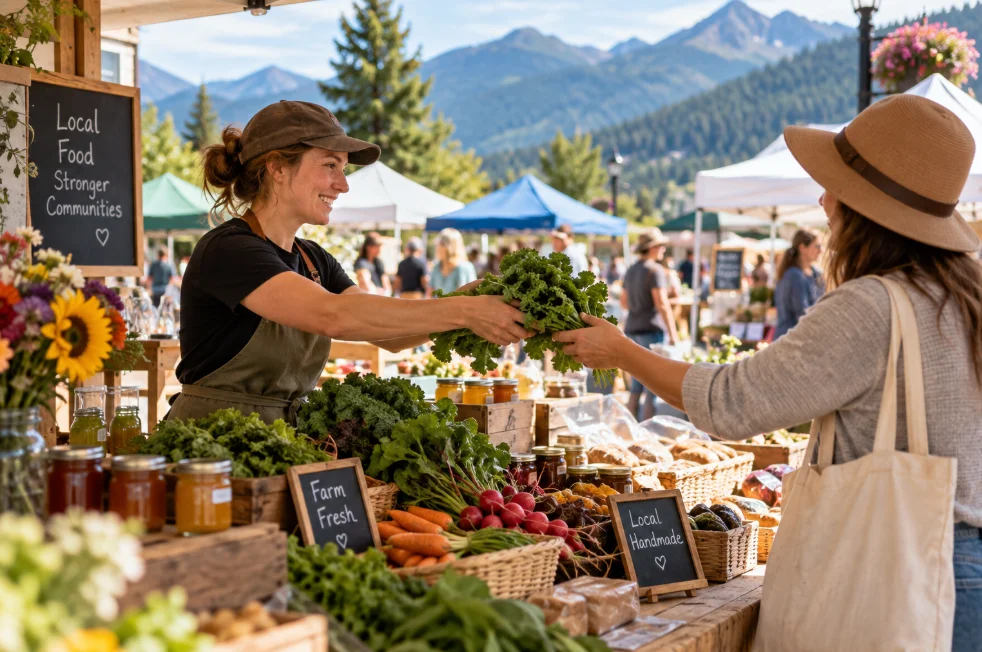
Selling at a farmers’ market can be a practical way to test a small food business, find customers for your harvest or introduce handmade products to your community. But getting a stall involves more than showing up with a table and something to sell. In British Columbia, you’ll need to find a market that accepts your products, understand its application requirements and work out whether your expected sales will cover the cost of attending.
For first-time vendors in the West Kootenays, the most useful starting point is a simple question: which market gives your particular product the best chance of finding customers?
Check Whether Your Products Are a Good Fit
Most BC farmers’ markets prioritize products made or produced by the people selling them. That makes them different from flea markets, where resale and second-hand merchandise may be part of the regular offering.
Before buying equipment or paying an application fee, confirm that your products fit the market’s rules and that there is room for another vendor in your category.
What “Made, Baked, Grown or Raised in BC” Means
According to the BC Association of Farmers’ Markets (BCAFM), eligible products must be made, baked, grown, raised or wild-harvested by the vendor within British Columbia. Individual markets can impose additional requirements, including restrictions based on where a vendor operates.
A market gardener selling vegetables they grew is a straightforward example. So is a potter selling their own ceramics or a baker offering products they prepared themselves.
Using purchased ingredients does not automatically disqualify a handmade product. What matters is whether you genuinely produce what you sell and meet the relevant market rules. Buying finished goods wholesale and putting your own labels on them is a different proposition.
There are also limits on how many vendors a market can accommodate. A strong application may still be declined if several established vendors already sell similar products.
For a broader view of vendor selection, site planning and market-day operations, it helps to understand how a community farmers’ market is organized. Market managers balance product diversity, available space and the experience they want to offer shoppers.
Choosing a Market That Matches Your Product and Travel Range
A market close to home is convenient, but its schedule and customer mix matter just as much.
In the West Kootenays, Rossland, Trail, Fruitvale and Castlegar offer different opportunities. Market schedules vary by community and season, with some operating weekly and others offering biweekly or occasional market days. Confirm current dates and vendor availability directly with the organizer before making plans.
Think about how those schedules affect what you sell. A grower harvesting vegetables early in the morning may prefer a different routine from a baker preparing fresh products overnight. An artisan with durable stock has more flexibility than a vendor carrying temperature-sensitive food.
Consider three realistic starting situations:
| Vendor | Main advantage | Biggest consideration |
|---|---|---|
| Small produce grower | Seasonal products encourage repeat purchases | Harvest timing, freshness and unsold produce |
| Home-based baker | Products can attract regular weekly customers | Food approvals, preparation time and shelf life |
| Handmade goods maker | Inventory can often be carried between markets | Slower purchase decisions and upfront material costs |
Visit a market as a shopper before applying. Notice which products sell steadily, how vendors display prices and whether people tend to browse or make quick purchases.
Understand the Vendor Application Process
There is no single application that automatically grants access to every farmers’ market in BC. Markets generally manage their own selection processes, schedules and vendor agreements.
The usual sequence is to review the market’s rules, contact the manager, submit an application, provide any supporting documentation and wait for approval before booking dates or paying applicable fees.
Information Market Managers Usually Request
Prepare a clear description of your business before opening an application form.
You may be asked for your contact details, operating location, product categories, photographs, production methods and preferred attendance dates. Some markets also review product quality, presentation or how your offerings complement existing vendors.
Be specific. Rather than describing your business as homemade food, explain that you prepare shelf-stable cookies, fruit preserves or refrigerated desserts, as applicable. The distinction can affect both eligibility and health requirements.
Include a realistic product list. If you intend to introduce new items later, ask whether they require additional approval.
It is also worth asking about occasional attendance. Some markets accommodate seasonal or casual vendors; others favour businesses that commit to a regular schedule.
Permits, Insurance and Other Supporting Documents
Acceptance by a market manager does not replace any government approvals required for your products.
Within Interior Health’s jurisdiction, lower-risk pre-packaged foods typically do not need authorization from an Environmental Health Officer. Higher-risk pre-packaged foods, eggs and frozen meat, poultry or fish require health approval. Preparing and serving food for immediate consumption at a temporary event follows a separate permit process, with some exemptions depending on the activity.
Food vendors should confirm their category before submitting an application.
MarketSafe training is designed for people producing and selling food at temporary markets. It is not a legislated requirement in itself, although individual markets may require it. MarketSafe is also not interchangeable with FOODSAFE Level 1.
Ask the manager whether vendor liability insurance is mandatory, what coverage is required and whether the market needs to be named on the policy. Business licence requirements can also depend on the municipality and how the market operates.
The safest approach is to get confirmation about your specific products and selling arrangements rather than relying on another vendor’s paperwork.
Work Out the Real Cost of Your First Market Day
Stall rent is usually only one part of the expense. A first-time vendor may also need equipment, insurance, packaging, payment processing and transportation before making a single sale.
Application Fees, Stall Rentals and Equipment
BCAFM publishes general fee ranges to help prospective vendors budget. These are provincial estimates, not confirmed rates for any particular West Kootenay market.
| Expense | BCAFM guidance | What to check |
|---|---|---|
| Application fee | C$0–100 | Whether it is refundable |
| Market membership fee | Typically C$5–50 | Whether membership is required |
| Stall rental | C$10–100 per market day | Daily, seasonal or prepaid rates |
| Tent, table and weights | Additional cost | Whether equipment can be rented |
| Insurance and permits | Varies | Coverage and product-specific requirements |
BCAFM also offers a separate optional provincial vendor membership program. That should not be confused with membership or participation fees charged by an individual market.
For your first appearance, borrowing a suitable table or renting approved equipment may make more financial sense than buying everything new.
Travel, Packaging, Card Fees and Unsold Stock
The less visible expenses often determine whether a market day is profitable.
A vendor travelling from Castlegar to Rossland should consider fuel, vehicle use, loading time and the hours spent away from production. A baker needs to account for ingredients, packaging, electricity and anything that cannot be sold later. An artisan should consider the time invested in producing stock, even if only a small portion sells that day.
Payment processing fees also reduce the amount retained from each transaction. Cash can reduce processing costs, but customers may expect debit or credit card options.
Keep reusable equipment separate from day-to-day expenses. A canopy bought for an entire season should not be charged in full against the profitability of your first market, although its cost still needs to be recovered over time.
A Simple Break-Even Calculation
Suppose you are selling handmade products at a market with the following hypothetical finances:
- Fixed market-day costs: C$70
- Product materials, packaging and transaction expenses: 50% of sales
- Contribution margin: 50%
Your break-even sales figure would be:
C$70 ÷ 0.50 = C$140
At C$140 in sales, the C$70 remaining after variable costs covers the C$70 in fixed expenses.
If sales reach C$250, the same assumptions leave C$125 after variable costs and C$55 after fixed costs.
That C$55 is not necessarily your final profit. The example excludes any labour, taxes, equipment depreciation or other costs not already included in the assumptions.
This distinction matters when comparing products. A baker may sell out but earn little after accounting for preparation time. An artisan may sell fewer items yet retain a larger margin on each sale.
A useful first-market target is not simply a sales number. Estimate the revenue needed to cover your costs and identify what you would consider a reasonable return for your time.
Prepare Your Stall Before Opening Day
Good preparation makes the market easier to manage and gives customers more confidence in what they are buying.
The final week should be about confirming quantities, checking equipment and organizing transportation rather than making last-minute changes to your product range.
Your Packing and Setup Checklist
BCAFM notes that vendors commonly supply their own 10-by-10-foot canopy, approximately 3 by 3 metres, along with tables and properly secured tent weights. Some markets provide rental equipment. Always confirm the organizer’s specific canopy requirements.
A practical packing checklist includes:
- Canopy, approved weights, table and appropriate display materials
- Clearly visible prices and product information
- Packaging, bags and any required labelling
- Charged payment terminal, backup battery and cash float
- Inventory list and a way to record sales
- Water, weather-appropriate clothing and personal supplies
- Food storage or temperature-control equipment, where required
- Copies of permits, insurance or approvals requested by the organizer
If your display is complicated, practise setting it up before market day. The goal is to know where everything belongs without searching through boxes while other vendors are unloading.
Leave space for customers to view products without blocking neighbouring stalls. Avoid placing fragile merchandise where bags, strollers or people moving through the market could knock it over.
Handling Weather, Payments and Product Storage
Weather deserves particular attention in mountain communities.
A warm afternoon can affect produce and food requiring refrigeration. Sudden rain can damage packaging, and wind can make an inadequately secured canopy dangerous.
Protect stock from direct sunlight and wet conditions, but do not improvise food-storage methods that fall short of the applicable health requirements. Temperature-sensitive foods need suitable equipment and monitoring, not just shade.
Prepare a backup payment method if mobile connectivity becomes unreliable. Cash can help, but a charged phone and a functioning card reader may prevent lost purchases.
For sellers with perishable inventory, bring quantities that reflect your best estimate of demand. Selling out slightly early can be preferable to taking home a large amount of unsellable food.
For artisans, the calculation is different. Durable inventory allows more experimentation, but transporting too much stock can make setup unnecessarily difficult.
Decide Whether the Market Is Worth Repeating
One market day rarely tells the whole story. Weather, competing community events, product availability and customer familiarity can all affect results.
Still, your first appearance should provide enough information to decide what to improve before attending again.
Track Profit, Customer Interest and Repeat-Buyer Potential
Record sales while the details are fresh, preferably by product rather than as a single total.
Pay attention to three measures:
- Financial return: Revenue minus product costs, market-day expenses and an allowance for your time.
- Customer response: Which items attracted questions, purchases or requests for different sizes and varieties?
- Repeat potential: Did shoppers ask when you would return or show interest in buying regularly?
Avoid confusing positive comments with demand. A product can receive plenty of compliments without generating enough sales to justify continued production.
For growers, ask whether a better harvest mix could improve the next visit. For bakers, examine which items sold early and which remained. For artisans, note whether certain price points or product sizes encouraged purchases.
When to Change Your Product Mix or Try Another Market
Use the first few appearances to test specific adjustments rather than changing everything at once.
Return with a similar selection if sales covered costs, customers responded positively and you can prepare the same quantities without excessive work.
Adjust your product mix if some items consistently outperform others. A grower may increase popular seasonal vegetables; a baker may reduce labour-intensive products with weak margins; an artisan may test a smaller selection of affordable pieces.
Consider another market if the schedule is difficult, travel consumes too much of the margin or shoppers are looking for something different from what you produce. A Saturday morning market may suit one business better than a Thursday afternoon event, even when both have comparable stall fees.
Pause before investing further if you have not resolved product approvals, cannot maintain suitable storage conditions or repeatedly lose money despite reasonable adjustments.
You can also ask the market manager for feedback. They may understand customer demand, seasonal attendance patterns and vendor-category gaps that are not obvious from one day behind a stall.
A successful first season does not have to mean attending every available market. For a small producer, two well-chosen market days with healthy margins and returning customers can be more valuable than a crowded calendar that leaves little time to grow, bake or make anything.
Start with a product you can produce reliably, a market whose rules and schedule fit your business, and a clear understanding of your costs. From there, each market day becomes a chance to build relationships with local customers while learning whether the business can support itself.