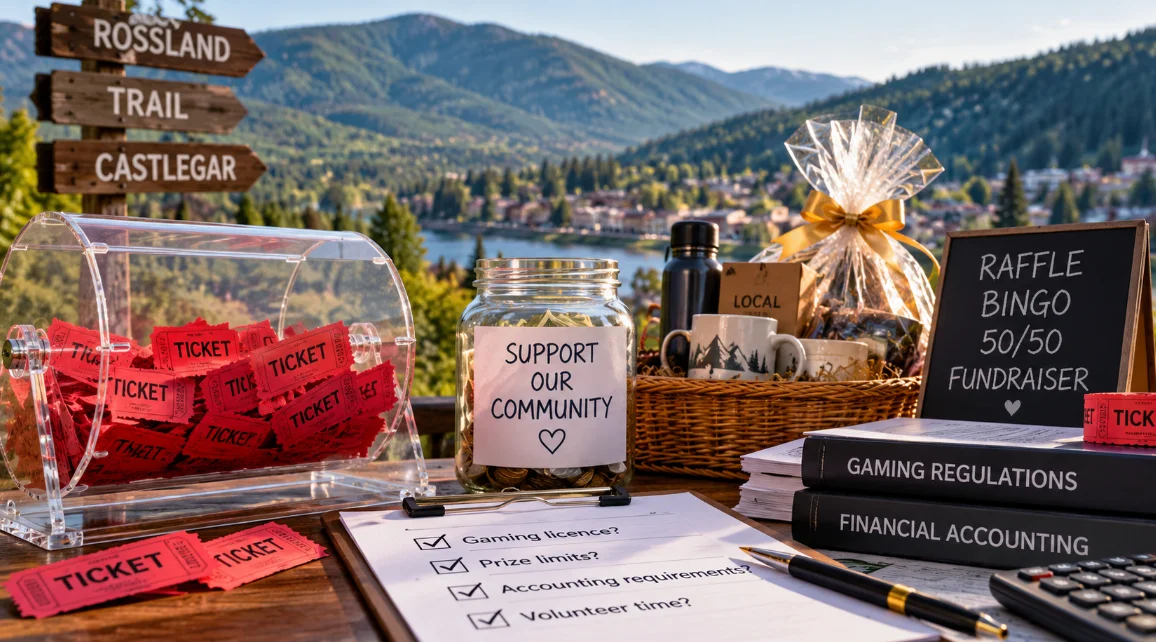
A donated gift basket and a few raffle tickets can seem like an easy way to raise money at a farmers’ market, craft fair or community fundraiser. But in British Columbia, the difference between a raffle, a free prize giveaway and a silent auction affects more than how winners are chosen. It can determine whether organizers need a gaming licence, what prizes they can offer and how the money must be accounted for.
For volunteer-run events in communities such as Rossland, Trail and Castlegar, choosing the right fundraising format means balancing potential revenue with administrative work, legal requirements and the time people can realistically contribute.
Decide What Your Fundraiser Needs to Achieve
Before collecting prizes or printing tickets, decide what success would look like.
Some fundraising activities are designed to generate money for a specific community project. Others encourage people to visit an event, recognize volunteers or introduce shoppers to local businesses.
These objectives are related, but they are not interchangeable.
Raising Money, Attracting Visitors or Thanking Supporters
A community association raising funds for new equipment may benefit from a licensed raffle with donated prizes. An organizer hoping to encourage shoppers to visit several market stalls might prefer a free promotional giveaway.
A volunteer appreciation event could offer a door prize without making fundraising its primary purpose.
The distinction matters because asking participants to pay for a chance to win introduces regulatory considerations that may not apply to a genuinely free giveaway.
A market might also collect direct donations, sell donated merchandise at fixed prices or invite bids on items provided by local businesses. These approaches can generate revenue without necessarily introducing a chance-based gaming activity.
Why a Simple Fundraiser Can Be Better Than a Complicated Draw
A raffle requires more than an attractive prize.
Organizers may need to apply for a licence, maintain ticket records, monitor sales, conduct an approved draw, deliver prizes and submit financial reports.
For a small volunteer team, that workload can consume a significant portion of the benefit.
Before choosing a draw, ask whether the expected fundraising revenue justifies the additional administration. A straightforward donation table or silent auction may produce a better result when volunteer capacity is limited.
Compare the Formats Before Choosing One
Four fundraising formats are particularly relevant to community markets and local events. Each creates different expectations for participants and different responsibilities for organizers.
| Format | What participants do | Main consideration |
|---|---|---|
| Prize raffle | Purchase an entry for a chance to win | Gaming licence, prize conditions and draw procedures |
| 50/50 draw | Buy a ticket for a percentage-based cash prize | Approved prize structure, ticket records and financial reporting |
| Free giveaway | Enter without a required payment | Ensuring the activity genuinely meets the conditions for a non-gaming promotion |
| Silent auction | Submit bids for an item | Clear bidding rules, payment collection and prize delivery |
Prize Raffle With Donated Items
A prize raffle offers a chance to win a specific item, such as a locally made gift basket, artwork or a certificate donated by a participating business.
When participants purchase tickets and winners are selected randomly, the activity ordinarily requires a charitable gaming event licence in BC.
Donated prizes can make a raffle more economical because organizers do not need to purchase everything they give away.
However, donated goods still have a fair market value. That value matters when checking the prize limits attached to a particular licence class.
For example, a Class B charitable gaming licence currently limits individual prizes to C$500 in fair market value. A donated item worth C$600 would not become eligible merely because the organizer received it free.
50/50 Draw
In a standard 50/50 draw, half the money collected from ticket sales is awarded as a cash prize, with the other half remaining with the licensed organization before applicable expenses.
If ticket sales total C$800, the winner receives C$400. The organizer’s share is C$400 before deducting eligible operating costs.
The prize depends on sales rather than being a fixed donated item.
BC’s Independent Gambling Control Office (IGCO) also permits other approved percentage-based structures, such as 60/40 or 70/30 draws.
For Class B licences, individual prizes cannot exceed C$500. That creates an important limitation for 50/50 organizers: a single draw generating C$1,200 in ticket sales would produce a C$600 prize, exceeding the Class B limit.
Organizers must structure their draws within the applicable restrictions instead of assuming that every 50/50 format is automatically permitted.
Free Door Prize or Shopper Giveaway
A genuinely free promotional draw generally does not require a charitable gaming licence when participants provide no payment or other consideration to enter.
The IGCO’s guidance also identifies certain door prizes as activities that may not require a licence, including an event where an admission ticket provides one entry and additional entries cannot be purchased.
The precise arrangement matters.
If shoppers must buy a product to receive an entry, organizers should review the rules before assuming the promotion is exempt. Calling a mandatory payment a donation does not remove the consideration element.
Free giveaways also need clear eligibility conditions, a transparent selection process and compliance with applicable promotional contest requirements.
Silent Auction or Fixed-Price Fundraising Sale
A conventional silent auction is different from a raffle because participants compete through bids rather than random chance.
The highest qualifying bidder receives the item under the published auction rules.
The IGCO identifies silent and regular auctions determined by bidding as examples of activities that generally do not require charitable gaming licences.
An organizer could auction a donated artwork or sell handmade items at set prices without turning the transaction into a prize draw.
But adding a paid random draw among bidders changes the arrangement. The actual mechanics, not the event’s name, determine whether gaming requirements apply.
Know When a Prize Draw Requires a Gaming Licence
British Columbia regulates charitable gaming under its provincial Gaming Control Act and the federal Criminal Code framework.
The Independent Gambling Control Office administers charitable gaming event licensing, including raffles and percentage-based draws.
The province introduced a revised Class A, B and C licensing structure in April 2026. Organizers using older fundraising guides should verify that the instructions still reflect the current system.
Consideration, Prize and Chance
The IGCO identifies three elements that determine whether an activity constitutes gambling:
- Consideration: Participants pay or exchange something of value to enter.
- Prize: Money, merchandise or another item of value can be won.
- Chance: The outcome is random or is not determined solely by skill.
When all three elements are present in a charitable fundraising activity, a gaming event licence is required.
For example, charging C$2 for a ticket that might win a donated gift basket involves payment, a prize and chance.
Removing the required payment may change the classification, provided participation is genuinely free. Replacing the draw with a conventional highest-bid auction removes the random selection element.
Who Can Apply for a Licence in BC?
The appropriate licence depends on the applicant and the intended use of proceeds.
Class A is designed for eligible charitable or religious organizations carrying out qualifying charitable activities.
Class B accommodates community fundraising groups, eligible organizations and individuals raising money for charitable purposes or community benefit. It has stricter limitations, including a maximum C$2 ticket price, a C$500 individual prize limit and a C$20,000 revenue ceiling per licence.
Class C applies to qualifying fairs or exhibitions designated by the IGCO’s general manager. Holding an event called a community fair does not automatically establish eligibility for this class.
Applications must be submitted through the IGCO’s Gaming Online Service at least 10 business days before the event starts. This is a minimum processing period, not a guarantee of approval.
For Class B events, the published application fee is C$25 when projected gross revenue is below C$5,000 and C$75 for projected revenue from C$5,000 to C$20,000.
A licence must be issued before organizers advertise the gaming event or sell tickets.
Age Limits, Ticket Conditions and Reporting
BC’s legal gambling age is 19. Organizers must ensure ticket purchasers and participants meet applicable eligibility requirements.
Ticket prices, sales periods, prize descriptions, draw procedures and locations must follow the approved licence.
For regular raffles, organizers generally retain ticket stubs or equivalent approved records so the winning entry can be identified and verified.
After the event, licence holders must submit a Gaming Event Revenue and Disbursement Report (GERDR) through the IGCO’s online system.
The deadline is 90 days after the final gaming event covered by the licence. The report documents actual revenue, expenses and the distribution or use of proceeds.
Make the Numbers Work for a Small Community Event
Gross ticket sales can make a fundraiser appear more successful than it really is.
A realistic budget should account for prize costs, licence fees, materials, payment processing and the time required to organize the event.
Donated Prizes Versus Purchased Prizes
Consider a hypothetical Class B raffle selling 300 tickets at C$2 each.
Total ticket revenue would be C$600.
Assume a C$25 application fee and C$40 in other eligible event expenses. With a donated prize worth C$120, the organizer has no cash expenditure for that prize.
The simplified financial result would be:
C$600 − C$25 − C$40 = C$535
If the organization instead purchased the prize for C$120, the remaining amount would fall to:
C$600 − C$25 − C$40 − C$120 = C$415
These are illustrative calculations, not actual market sales or a guarantee that every proposed expense is deductible from gaming proceeds. The licensing rules determine which expenses may be paid using gaming revenue.
Donated prizes can improve the financial result, but obtaining them also takes volunteer time and community support.
When a Direct Donation May Be the Better Choice
If a small group expects to collect only a modest amount, a raffle may not justify the effort.
A direct donation campaign avoids the complexity of managing a prize draw. A fixed-price sale can also provide a straightforward fundraising method when organizers have donated goods.
The better choice is the one that leaves the greatest useful contribution after costs while remaining manageable and transparent.
Set Up a Draw That Volunteers Can Run Properly
A licensed raffle should operate according to written procedures that volunteers can understand before ticket sales begin.
Ticket Records, Draw Procedures and Winner Notification
Assign responsibility for ticket distribution, sales reconciliation, the draw and prize delivery.
Keep ticket records consistent with the licence conditions. Volunteers should know where sales money is held, how ticket numbers are tracked and who is authorized to conduct the draw.
The winning entry must be selected using the approved procedure. Do not substitute a convenient online random-number generator for a manual draw without checking the applicable licence rules.
Communicate the draw date, prize description, winner notification process and any relevant restrictions clearly.
What Happens if the Event Is Postponed or Cancelled?
Weather and unexpected closures can disrupt community events, particularly outdoor markets.
A postponement should not automatically lead to an unapproved change in the raffle’s draw date, location or other licensed conditions.
The IGCO’s guidance explains that amendments after licence approval are limited and generally cannot be made once ticket sales have begun.
If the event cannot proceed, contact the IGCO before changing arrangements. Keep purchasers informed and follow the regulator’s directions concerning any required refunds, prize obligations or reporting.
Keep Prize Information Clear and Verifiable
Prize descriptions should reflect what winners will actually receive.
For donated services or gift certificates, confirm expiry conditions, availability and any restrictions before advertising the draw.
The prizes must match those approved on the licence. Organizers should also confirm how winners will receive them and maintain records demonstrating that the prizes were awarded.
A donated prize is still a commitment to the participant who wins it.
Keep Online Promotion and Participation Clear
Digital tools can make community fundraising easier to publicize, but online advertising, electronic payments and digital gaming systems are different activities.
Advertising a Draw Online Is Not the Same as Running It Online
Posting about a licensed raffle on a community website or social media page does not automatically authorize online ticket sales.
BC’s guidance distinguishes approved Electronic Raffle Systems (ERS) from other digital tools, including electronic funds transfers, online payment services and emailed copies of manually generated tickets.
An ERS can be approved for a Class A ticket raffle. It is not permitted under Class B or Class C licences.
Other digital tools may be used under specified conditions, but Class B and C draws must retain a manual winner-selection process rather than using an electronic random-number generator.
Organizers should disclose their proposed technology in the application and follow the licence conditions rather than assuming an ordinary payment app provides all necessary authorization.
Avoid Confusing Fundraising With Other Forms of Wagering
Posting the details of a community prize draw on social media does not turn the fundraiser into an online game. Selling tickets electronically is a separate question, and organizers need to follow the conditions attached to their particular licence.
The term xmr casino refers to cryptocurrency-based online wagering, not an electronic version of a community fundraising raffle.
That distinction matters because a similar-looking digital interface does not make different activities legally interchangeable. BC regulates commercial gambling separately from charitable gaming, and the province identifies BCLC’s PlayNow.com as its only legal online gambling site.
For a community market, the priority is to explain entry rules clearly, obtain the necessary approvals and keep accurate records. The technology should support the fundraiser’s approved format rather than change how participation or winner selection works.
Review the Results Before Planning the Next Event
After a fundraiser, compare the actual money raised with the time, materials and administrative work it required.
Calculate net proceeds rather than celebrating gross ticket sales. Record how long volunteers spent obtaining prizes, organizing entries, handling payments and completing reporting.
Ask whether participants understood the rules and whether the event created any confusion or complaints.
A raffle that raises a meaningful amount with donated prizes and manageable administration may be worth repeating. A draw that produces limited net revenue while consuming several weeks of volunteer effort may not be.
For smaller communities, dependable fundraising often comes from choosing a format that suits the people organizing it. A well-managed silent auction, direct donation campaign or appropriately licensed raffle can all support local projects. The strongest choice is one that fits the fundraising goal, follows the rules and leaves volunteers willing to help again.