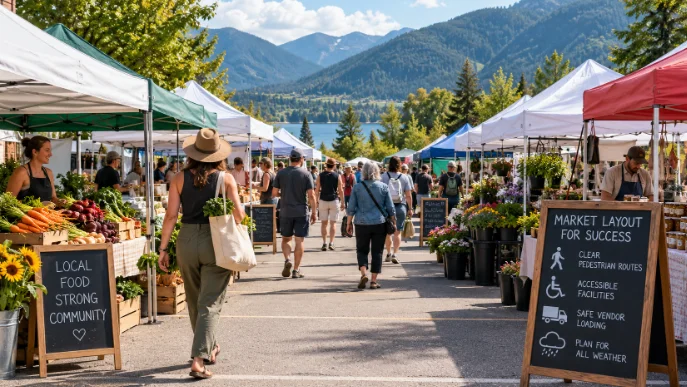
An outdoor farmers’ market can have excellent vendors and a great location yet still struggle because shoppers cannot move comfortably between stalls, delivery vehicles arrive too late or a sudden change in weather disrupts the entire site. For organizers in the West Kootenays, a workable market layout needs to account for more than the number of tents that fit in a parking lot.
The strongest setup starts with clear pedestrian routes, accessible facilities, safe vendor loading and a realistic plan for rain, wind, heat and wildfire smoke. Those decisions are much easier to make before market day than when vendors are already unloading their vehicles.
Choose a Site You Can Actually Operate
A suitable market site needs enough room for vendors, shoppers and essential services without creating conflicts between them. Visibility and atmosphere matter, but neither compensates for poor access, inadequate facilities or complicated approvals.
Street Market, Parking Lot or Park?
Each location comes with different advantages.
A closed street can create a lively pedestrian environment and connect vendors with nearby businesses. However, traffic management, parking changes, emergency access and municipal approval can make it complicated to organize.
A parking lot often provides a relatively level surface, straightforward vehicle access and flexible stall arrangements. The trade-off is that parking capacity disappears once vendors occupy the space. Organizers also need to establish who controls the lot and whether it can be closed to regular traffic.
A park or green space may offer shade, seating and a welcoming atmosphere. Uneven ground, restricted vehicle access, limited electricity and sensitivity to wet conditions can make setup harder.
For a small community market, the best site is usually the one that allows the organizers to operate consistently without excessive equipment, staffing or infrastructure costs.
Site layout is only one part of planning a farmers’ market from the ground up, alongside budgeting, vendor recruitment and the approvals required before opening day.
Washrooms, Water, Power and Accessible Routes
Before committing to a location, walk through it as though the market were already operating.
Find the nearest washrooms. Check whether they are accessible, whether visitors can reach them without crossing vehicle routes and whether the facilities will be available throughout market hours.
Identify drinking water, electrical connections and any equipment needed for food vendors. A public water tap does not automatically mean vendors have access to a suitable food-service water supply.
Electricity needs particular attention. Extension cords running across pedestrian routes create trip hazards, while generators introduce noise, exhaust and additional safety considerations.
Accessibility should influence site selection from the beginning. British Columbia’s guidance for inclusive events recommends firm, stable, well-marked pathways and a minimum clear width of one metre for accessible travel. That is a basic planning reference, not a guarantee that a particular market layout satisfies every applicable accessibility or emergency-access requirement.
A site that looks level from the road may contain gravel, steep transitions, broken pavement or drainage channels that make movement difficult.
Check Municipal Event Requirements Early
In Rossland, the City requires an Outdoor Special Event Application for many organized activities on City land, including events using roadways or public facilities outside their normal purposes.
Applications must be submitted at least eight weeks before the event. Activities requiring street closures or other special arrangements may need additional municipal review.
The City’s published policy also requires a minimum of C$2 million in comprehensive liability insurance for events on City property, with the City of Rossland named as an additional insured.
For parks and fields, the City prohibits staking tents into the ground because of underground irrigation infrastructure. Approved structures must instead use suitable weights, and vehicle access generally requires specific authorization.
These are Rossland requirements, not universal rules for every BC municipality. Organizers in Trail, Castlegar or elsewhere should check the conditions that apply to their own location.
Build a Layout That Works for Shoppers and Vendors
A good farmers’ market layout encourages browsing without forcing people into bottlenecks. Vendors need enough space to work, while shoppers need unobstructed routes between displays, seating and essential facilities.
Arrange Produce, Prepared Food, Artisans and Seating
Consider a hypothetical 16-vendor market arranged in two rows of eight stalls, with a central pedestrian corridor and access from both ends.
Assume each vendor has approximately a 3-by-3-metre space. The final dimensions would depend on the site, accessibility needs, fire and emergency access requirements, and any conditions imposed by the approving authority.
Rather than filling every available metre with stalls, reserve space for movement and services.
A workable arrangement might place:
- Produce growers along the main shopping route, where customers can browse seasonal offerings.
- Bakers and packaged-food vendors near complementary products, without blocking the entrance.
- Prepared-food stalls near approved water, power and waste facilities.
- Artisans along a route where shoppers can pause without stopping pedestrian traffic.
- Seating near food vendors but outside the main circulation area.
- Waste and recycling stations in convenient, clearly marked locations.
Not every category needs its own designated section. The aim is to avoid congestion while helping shoppers discover different types of products.
For instance, placing every popular food vendor directly at the entrance may create crowding before visitors have reached the rest of the market.
Keep Pedestrian Routes and Emergency Access Clear
Draw the site plan around circulation routes rather than arranging stalls first and fitting walkways into whatever remains.
People using wheelchairs, mobility scooters, walkers or strollers should be able to reach the stalls and essential amenities without navigating obstacles.
During a pre-market accessibility walk-through, check whether:
- The route from accessible parking or drop-off areas is firm and unobstructed.
- Customers can approach stall displays without stepping onto unstable ground.
- Electrical cables and equipment do not cross walking routes unnecessarily.
- Accessible washrooms and seating are easy to locate.
- Signs can be read from both standing and seated positions.
- Wheelchair users can turn and move through busier areas without being trapped by queues.
Keep emergency vehicle access separate from pedestrian circulation where required. The necessary dimensions must be confirmed with the appropriate authorities rather than assumed from a generic layout template.
Separate Vendor Loading From Public Shopping Hours
Vendor loading is one of the easiest ways to create unnecessary conflict at a market.
Assign arrival windows, loading locations and a clear vehicle exit route. Vendors should understand that driving through public shopping areas is not an acceptable shortcut once the market opens.
A practical sequence is to mark the site first, allow approved vehicles to unload, move vehicles to designated parking and complete a final safety inspection before admitting shoppers.
Apply the same discipline at closing. Customers should be clear of vehicle routes before dismantling and loading begin.
For markets in constrained downtown locations, staggered arrival and departure times may reduce congestion.
Prepare for Weather That Can Change the Plan
Outdoor markets need decisions that can be made quickly when conditions deteriorate. A weather plan should identify who has authority to act, which conditions require changes and how everyone will receive instructions.
Wind, Rain and Temporary Canopies
Even a relatively ordinary afternoon can become hazardous when wind catches the roof of an unsecured canopy.
Require vendors to use weights and anchoring systems appropriate to their structures and the site conditions. Follow manufacturer instructions and any requirements imposed by the municipality or property owner.
Do not allow vendors to tie tents to trees, street furniture or nearby structures without authorization.
Rain presents different problems. Water pooling on canopy roofs, slippery surfaces, damaged packaging and saturated grass can affect both safety and operations.
After heavy rainfall, assess whether the ground remains suitable for vendors, mobility devices and pedestrians. A grassy site that worked well the previous week may no longer be practical.
Heat and Wildfire Smoke
WorkSafeBC advises employers to assess heat and wildfire-smoke risks before conditions become hazardous. Its June 2026 guidance emphasizes adjusting schedules, reducing strenuous outdoor work, monitoring air quality and recognizing signs of heat stress.
Market organizers should identify shaded rest areas, access to drinking water and opportunities for workers to take breaks.
Wildfire smoke requires a different response. British Columbia’s Air Quality Health Index provides information about outdoor air pollution and associated health risks. The reported conditions, local advisories and the duration of exposure should inform decisions about outdoor operations.
An open-sided canopy does not provide meaningful protection from fine smoke particles.
A useful decision framework is:
| Decision | Possible circumstances | Organizer response |
|---|---|---|
| Continue | Conditions remain manageable and the site is safe | Monitor forecasts and reassess throughout the event |
| Modify | Heat, moderate rain or manageable operational disruption | Adjust hours, provide additional breaks or relocate stalls |
| Postpone | Conditions create significant risks that may improve later | Notify vendors and shoppers, and confirm a revised schedule |
| Cancel | Unsafe wind, severe weather, dangerous smoke conditions or an official restriction | Close or suspend operations and follow the emergency plan |
These are planning categories, not official weather thresholds. Decisions must reflect actual conditions, applicable warnings and the vulnerability of the people involved.
The BC Association of Farmers’ Markets provides an Emergency Response Guide designed to help market organizations prepare for disruptions, including disasters and evacuations.
When an Indoor Backup Makes Sense
Rossland Mountain Market’s historical programming included both outdoor summer markets and indoor winter events, illustrating why seasonal flexibility matters in mountain communities.
An indoor venue can help during cold or wet periods, but it introduces different considerations: rental availability, occupancy limits, ventilation, accessible entrances, washrooms and food-service arrangements.
An indoor backup should be assessed and approved in advance where required. Moving into a building at the last minute is not necessarily possible under the same permissions used for an outdoor event.
For smaller markets, planning a few indoor seasonal dates may be more manageable than maintaining a fully flexible relocation arrangement.
Assign Market-Day Responsibilities Before Anyone Arrives
A market cannot rely on everyone assuming someone else is handling a problem.
Even a small volunteer-run event benefits from clearly assigned responsibilities. One person may hold several roles, but every critical task should have a named owner.
Market Manager, Vendor Coordinator and Volunteer Roles
The market manager should have final authority over opening, pausing or closing the event, including decisions involving severe weather or safety concerns.
A vendor coordinator can handle arrivals, stall assignments, missing equipment and operational questions. Volunteers may assist with signage, wayfinding, customer enquiries and waste collection.
For a small market, a practical division might be:
- Market manager: Site approval, safety decisions, incident response and communication with authorities.
- Vendor coordinator: Stall assignments, arrival schedules, setup checks and vendor concerns.
- Volunteer lead: Staffing, public information, accessibility assistance and routine site checks.
Assign a backup decision-maker in case the manager is unavailable.
Emergency Contacts, First Aid and Public Information
Keep emergency contacts accessible to the team, along with the approved site plan, emergency procedures and any relevant municipal contacts.
The City of Rossland requires outdoor event organizers to provide a fully stocked first aid kit accessible to event staff, volunteers and attendees. Larger or higher-risk events may require additional first aid arrangements.
Identify who will respond to an incident and who will direct emergency services to the correct entrance.
For public communication, use one authoritative channel for schedule changes and closures. Vendors should receive the same instructions as shoppers, preferably before conflicting information begins circulating.
The Final Site Walk-Through
Complete a final inspection before opening, ideally with the market manager and the person responsible for site operations.
Use this checklist:
- Entrances and pedestrian routes: Clear of vehicles, equipment and obstructions.
- Accessible paths: Firm, usable and connected to stalls, seating and washrooms.
- Canopies: Properly weighted, assembled and positioned according to site rules.
- Electrical equipment: Connections protected, cords secured and generators appropriately located.
- Food vendors: Required approvals verified, with suitable storage and service arrangements in place.
- Waste stations: Bins positioned without blocking walking routes or attracting wildlife.
- Signs and information: Market hours, entrances, facilities and contact points clearly identified.
- Emergency arrangements: Access routes open, first aid supplies available and designated responders informed.
- Weather conditions: Forecasts, current alerts and contingency decisions reviewed.
- Vendor vehicles: Loading completed and public areas clear of unauthorized traffic.
In Rossland, waste management also involves wildlife awareness. The City’s outdoor event policy requires organizers to remove garbage after events and emphasizes preventing waste from attracting bears and other animals.
The final inspection should be more than a paperwork exercise. Walk the routes customers will use and look for problems from their perspective.
What to Review After the Market Closes
A market layout rarely works perfectly on its first outing. Once the site is cleared, record what actually happened rather than relying on impressions several weeks later.
Did the entrance become crowded? Were customers able to reach every stall? Did vendors spend too long unloading? Were the washrooms easy to find? Did rain create an unexpected slippery area?
Ask vendors for specific operational feedback. A stall that appeared well positioned on the site plan may have experienced poor visibility, excessive sun or an awkward loading route.
Separate problems that can be fixed immediately from those requiring a larger decision. Moving a sign is straightforward. Changing a vehicle entrance, relocating food stalls or reducing overall capacity may require revisions to the site plan and relevant approvals.
Keep a short record of incidents, weather conditions, attendance patterns and layout adjustments. Those notes become particularly useful when volunteer teams change between seasons.
For a community market, good site planning should be almost invisible to visitors. Shoppers can move comfortably, vendors can concentrate on their products and everyone knows what to do when conditions change. That reliability makes a market easier to operate and gives people a reason to return.