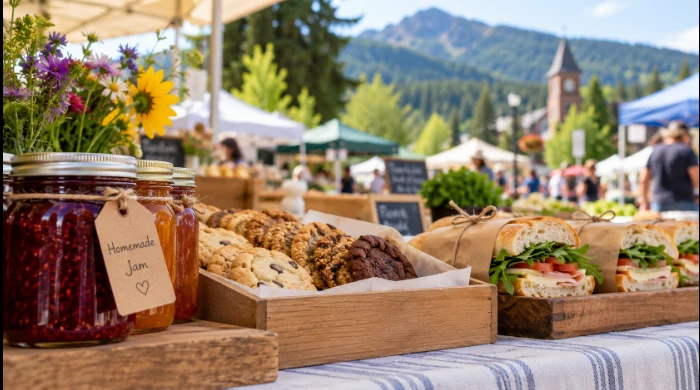
A jar of homemade jam, a box of cookies and a tray of fresh sandwiches may all look at home on a farmers’ market table, but they don’t necessarily fall under the same food safety requirements. In British Columbia, the approvals you need depend on what you’re selling, how the food is prepared and whether customers will eat it immediately.
For vendors in Rossland and the wider West Kootenay region, understanding these differences before applying for a stall can prevent rejected applications, wasted preparation time and last-minute changes to a market-day menu.
Start With the Food You Plan to Sell
Not every food sold at a BC farmers’ market requires health approval. Whole fresh produce and qualifying lower-risk pre-packaged foods can generally be sold without prior authorization from an Environmental Health Officer (EHO). Higher-risk foods require additional review, and preparing meals at the market follows a separate approval process.
The BC Centre for Disease Control (BCCDC) provides the provincial Guideline for the Sale of Foods at Temporary Food Markets. Interior Health applies this framework in communities across the BC Interior, including the West Kootenays.
The first question is not simply whether food is homemade. It’s whether the finished product can support the growth of harmful microorganisms or the production of toxins.
Whole Produce and Lower-Risk Packaged Foods
Whole fresh fruits and vegetables are generally permitted at temporary food markets without a separate health application under the temporary market guideline.
Many shelf-stable foods also qualify as lower risk. BCCDC examples include plain bread, certain muffins, cookies, popcorn, dried fruit, honey and some properly prepared preserves.
Lower-risk foods are generally characterized by conditions that prevent the growth of disease-causing microorganisms. The guideline identifies a water activity of 0.85 or less or a pH of 4.6 or less as relevant criteria, while recognizing that processing methods and other factors can still affect a product’s classification.
For vendors, this distinction has practical consequences.
A plain loaf of bread may fit the lower-risk category, while a pastry filled with custard or whipped cream generally does not. A properly prepared fruit jam may qualify, but a low-acid vegetable preserve cannot automatically be treated the same way.
Qualifying lower-risk foods may be prepared in a home kitchen for sale at temporary food markets, provided the applicable conditions are met. The guideline recommends displaying a notice informing customers that the food was prepared in a kitchen not inspected by a regulatory authority.
That permission does not automatically extend to grocery stores, online sales or other retail channels.
Higher-Risk Foods That Need Additional Review
Higher-risk foods can support microbial growth unless suitable preparation, processing and storage controls are maintained.
BCCDC examples include dairy products, custard-filled pastries, hummus, pesto, certain fermented foods, meat pies and foods containing perishable fillings.
Interior Health requires approval for higher-risk pre-packaged foods, eggs and frozen meat, poultry or fish sold through temporary markets.
A vendor cannot simply prepare a higher-risk product in an ordinary home kitchen, refrigerate it and assume it is eligible for sale. Approval may depend on production in an inspected commercial facility, supporting documentation and appropriate temperature controls.
For someone hoping to sell homemade perogies or refrigerated cheesecake, access to an approved production kitchen may be a more significant hurdle than finding an available market stall.
Match Your Selling Method to the Right Approval Process
Two vendors can sell similar ingredients while facing different requirements because one brings packaged goods and the other prepares food for immediate consumption.
Interior Health distinguishes between temporary market vendors selling pre-packaged products and temporary food services preparing or serving ready-to-eat items.
Selling Food Prepared and Packaged Before Market Day
This is the usual route for vendors selling packaged baking, preserves or other products prepared in advance.
For qualifying lower-risk products, EHO authorization is typically unnecessary. Vendors must still follow the provincial guideline, protect food from contamination and satisfy the market manager’s requirements.
Higher-risk pre-packaged foods require a different process. Vendors submit an application and supporting information for health authority review. If approved, Interior Health issues a Letter of Confirmation identifying the permitted products.
Approval should not be assumed to cover new recipes or products that differ materially from those reviewed.
For example, a vendor approved to sell a particular refrigerated sauce should check before adding a different sauce with new ingredients or processing requirements.
Cooking or Serving Ready-to-Eat Food at a Market
Preparing hot lunches, assembling ready-to-eat meals or making beverages at a stall can fall under Interior Health’s Temporary Food Service requirements.
The distinction is particularly relevant to community markets that combine farm produce with prepared food stands.
Interior Health updated its temporary food service application process effective October 1, 2025. Under the current process, applications generally must be submitted at least 14 days before an event. Late applications are subject to a C$50 administrative fee and may not be processed.
Temporary Food Service permits are limited to a maximum of 14 operating days per calendar year. Vendors intending to provide food service more frequently need to pursue the appropriate ongoing food premises or mobile food premises approval.
Some limited activities are permit-exempt under specified conditions. Examples include black coffee, popcorn and certain beverages made from commercially prepared mixes. These exemptions are conditional and do not mean that any food may be prepared at home and served without approval.
The practical distinction is straightforward: selling packaged cookies is not the same activity as preparing sandwiches or serving cooked food at a market booth.
Offering Samples to Customers
Sampling can help customers discover unfamiliar products, but it changes how food is handled at the stall.
For qualifying lower-risk foods, sampling may be permitted without a separate Temporary Food Service application when the BCCDC guideline’s conditions are followed.
The guideline recommends preparing and portioning samples before arriving, except for fresh produce, and serving them individually rather than leaving shared containers for customers to handle.
When sampling occurs, suitable handwashing facilities are expected. The guideline describes running water, liquid soap and paper towels, with a 22.7-litre container fitted with a spigot generally acceptable as a water source.
Sampling that goes beyond the temporary market guideline may require Temporary Food Service approval. Heating products, preparing dishes or serving higher-risk samples can change the regulatory requirements.
Before offering tastings, explain exactly what you intend to serve and how it will be handled.
Product Examples: What Should a Vendor Check?
Product names alone rarely provide enough information to determine approval requirements. Ingredients, processing, storage and selling methods all matter.
The following comparison highlights what vendors should establish before applying.
| Product | Likely regulatory consideration | What to verify |
|---|---|---|
| Fresh vegetables | Whole, unprocessed produce generally does not require EHO approval | Whether products are sold whole or cut and prepared |
| Bread and baked goods | Plain shelf-stable baking may qualify as lower risk | Fillings, toppings, refrigeration and packaging |
| Jam and preserves | Some qualify as lower risk | Recipe, acidity, processing method and possible testing |
| Eggs | Health approval is required under Interior Health’s market process | Handling, refrigeration, labelling and producer documentation |
| Frozen meat | Higher-risk category requiring approval | Approved processing source, frozen transport and storage |
| Hot meals | Usually require Temporary Food Service approval | Preparation location, menu, equipment and operating days |
| Prepared beverages | Requirements depend on ingredients and preparation | Whether a conditional permit exemption applies |
| Food samples | Limited lower-risk sampling may be allowed | Portioning, handwashing, ingredients and serving method |
Consider a small producer making fruit preserves. A conventional fruit jam prepared using an appropriate method may meet the lower-risk criteria. A vegetable-based spread with different acidity and processing characteristics may need additional assessment.
The two products could be sold in identical jars, but their appearance says little about their safety classification.
Do not assume that refrigeration makes an otherwise higher-risk homemade food eligible for temporary market sale. Temperature control is necessary for many approved products, but it does not replace approval of the preparation facility or process.
The same principle applies to meat and fish. BCCDC’s temporary market guideline sets conditions for approved products, including appropriate processing, packaging and frozen storage. Refrigerated rather than frozen sales require further discussion with the health authority.
Documents to Have Ready Before Your First Market
Most approval delays are easier to avoid when vendors prepare their information before contacting the market manager.
A basic application package should clearly identify what is being sold, where it is produced and which food safety requirements apply.
Depending on the products and selling method, useful documentation may include:
- A complete product or menu list, including ingredients and preparation methods
- Business and producer contact information
- The address and approval status of the preparation facility
- A Letter of Confirmation, food premises approval or relevant permit, where required
- FOODSAFE or MarketSafe training records, as applicable
- Product testing or processing documentation when requested
- A description of refrigeration, frozen storage or hot-holding arrangements
- Packaging and labelling details, including applicable allergen information
Market acceptance and public health approval are separate matters.
Food-vendor approvals are only one part of the market organizer’s wider planning responsibilities, which also include site access, vendor coordination and public safety.
When You Need a Letter of Confirmation
For higher-risk pre-packaged foods, Interior Health directs vendors to submit the application included in the BCCDC temporary market guideline, along with the required supporting information.
An Environmental Health Officer reviews the application and may request clarification or additional documentation.
If the proposed products are approved, a Letter of Confirmation is issued. Interior Health instructs vendors to give a copy to the market manager and display it at their booth.
The letter should be checked for validity and conditions before reuse. If it is no longer valid, the vendor must reapply. Changes in products or preparation methods may also require further review.
A Letter of Confirmation for temporary markets does not authorize unrelated retail or online food sales. Those activities may require separate food processor or manufacturer approval.
Food Safety Training and Preparation-Site Information
MarketSafe was developed specifically for people who produce or sell food at temporary markets. It covers safe handling, sanitation, storage and common food safety risks.
FOODSAFE Level 1 provides broader food safety training and may be required for particular food operations.
For lower-risk temporary market vendors, Interior Health recommends FOODSAFE or MarketSafe training. For higher-risk vendors, training may be required as part of the approval process.
Temporary Food Service operations have additional requirements. Under Interior Health’s October 2025 guidance, at least one food handler with a valid FOODSAFE Level 1 certificate must be on site during a permitted temporary food service.
Training does not substitute for a required permit or approval of a preparation facility.
Food labelling deserves separate attention. The Canadian Food Inspection Agency regulates requirements for many pre-packaged foods, including ingredient and allergen declarations, subject to applicable exemptions. A product’s lower-risk classification does not automatically exempt it from federal labelling rules.
Where to Confirm the Rules in the West Kootenays
For vendors selling in Rossland, Trail, Fruitvale or Castlegar, Interior Health is the relevant regional health authority for food safety enquiries.
Its food premises guidance explains the different application routes for temporary market vendors, temporary food services and food processors.
Interior Health and the Temporary Food Markets Guideline
Begin with the BCCDC’s Guideline for the Sale of Foods at Temporary Food Markets. Its appendices identify lower-risk and higher-risk examples, along with requirements for eggs, meat and other animal products.
Then review Interior Health’s current Food Premises guidance to determine which application process applies.
For higher-risk temporary market vendor applications, Interior Health lists its centralized intake address as EPHDirect.
Temporary Food Service applications use their own current forms and procedures. Vendors should not reuse outdated applications from earlier seasons.
Allow enough time for review, particularly if you are introducing a new product, using a commercial kitchen or planning to prepare food on site.
What to Do When Your Product Does Not Fit a Simple Category
Some products sit between familiar classifications.
A fermented vegetable product, unusual sauce or low-sugar preserve may not fit neatly into a general list. Product testing, acidity, water activity or processing details may be necessary to establish the appropriate classification.
If a recipe is difficult to classify, prepare a concise description covering:
- All ingredients and their approximate proportions
- How and where the product is prepared
- Heating, cooling, preservation or fermentation methods
- Packaging and intended shelf life
- Storage conditions before and during the market
- Whether customers will consume it immediately
An EHO can then assess the actual product rather than having to interpret a vague description such as homemade dip or artisan preserves.
This is particularly worthwhile before investing in labels, packaging or large quantities of ingredients.
Common Mistakes That Delay Vendor Approval
Food safety requirements become more manageable when vendors separate product eligibility from market participation.
Several avoidable mistakes can disrupt preparations:
Assuming every homemade baked good is lower risk. A plain muffin and a cream-filled pastry may require completely different arrangements.
Treating the market manager’s acceptance as health approval. The manager may approve your business for a stall without being authorized to approve higher-risk food production.
Using a home kitchen for higher-risk products. Refrigeration and careful handling do not replace the need for an approved preparation facility where required.
Applying under the wrong process. Pre-packaged market products and temporary ready-to-eat food services follow different approval routes.
Changing recipes after approval. New ingredients or processing methods can affect the classification and validity of existing documentation.
Overlooking sampling and labelling. Free tastings still involve food handling, while packaged products may need ingredient, allergen and other information.
For a first-time vendor, the most efficient approach is to settle three questions before submitting a market application: what is the product’s risk category, where may it legally be prepared, and how will it be sold or served?
A grower selling whole vegetables may have a relatively straightforward path. A baker offering shelf-stable products needs to verify recipes and packaging. Someone preparing hot meals or higher-risk foods should expect a more involved approval process.
Getting those details right early leaves more time for the part of market selling that customers actually see: fresh products, clear information and conversations with the people who grow or make their food.
Sources and editorial notes: Regulatory guidance is based on Interior Health’s Food Premises information and its October 2025 Health Approval for Temporary Food Services guideline, the BC Centre for Disease Control’s Guideline for the Sale of Foods at Temporary Food Markets, and Canadian Food Inspection Agency food labelling guidance. Product-specific requirements should be confirmed with the responsible health authority before sales begin.